


Facing complaints about campus Wi-Fi, Gettysburg College engaged Velaspan in late 2025 for a wireless coverage assessment—key to determining whether a new wireless network or targeted improvements to the existing network were in order.
What followed was a truly novel engagement that wove Gettysburg’s students and related objectives into our shared wireless goals. Spoiler: all parties passed with flying colors!
Here’s the story.
The Challenge
Despite Civil War associations, Pennsylvania’s Gettysburg College is famously future-facing. The liberal arts college counts a Nobel Prize winner among its distinguished alumni. And in 2025, Gettysburg College faced a decidedly modern problem: rumblings among faculty, staff, and students that Wi-Fi on its 260-acre campus was faltering.
College IT learned about the Wi-Fi issues not directly but via the social media platform YikYak, where anonymous grievances by Gettysburg College students received as many as 500 upvotes (the equivalent of a thumbs up) each day. In September 2025, Gettysburg College’s Student Senate brought the mounting frustrations to the college’s president and trustees.
Gettysburg College IT distributed a wireless-focused student survey. Responses revealed connectivity issue patterns specific to a few usage scenarios and campus locations. It also hinted at confusion around some user activity, such as which wireless network/SSID to use when connecting.
Knowing a formal network assessment was the next step, Gettysburg College CIO Gavin Foster reached out to Velaspan.
Our shared aha moment came fast.
In our very first meeting, just as our team asked Gettysburg, “Are you really listening to students?” Gettysburg IT conceded, “We haven’t been listening well enough.” Leadership was eager to course-correct, and Velaspan was eager to help. Together we hatched a plan to rectify the college’s IT problems and more.
Gettysburg College, we mutually decided, would appoint four work-study student ambassadors to a unique Gettysburg-Velaspan engagement: a project manager, a data collections engineer, and two public relations coordinators.
Next, Velaspan, alongside college IT and respective departments, would train these four students in their respective areas of focus. From there we would embed them across all three phases of our standard wireless assessment process: discovery, analysis, and communication.
At the same time, we would engage the college student body as a whole via listening and learning sessions designed to better understand students’ Wi-Fi experiences and improve their understanding of how Wi-Fi works.
If all went as hoped, the novel plan would accomplish four things:
- Diagnose RF issues and determine next steps: targeted remediation of the existing network or a full wireless network redesign?
- Create a peer-to-peer feedback loop to reduce user error and increase student ownership of the college’s Wi-Fi profile
- Close the gap between students and IT
- Advance Gettysburg College’s commitment to listening to students and offer real-world learning application
With no time to waste, Velaspan, Gettysburg IT, and campus leadership began to operationalize.
Student-Centric Discovery Process
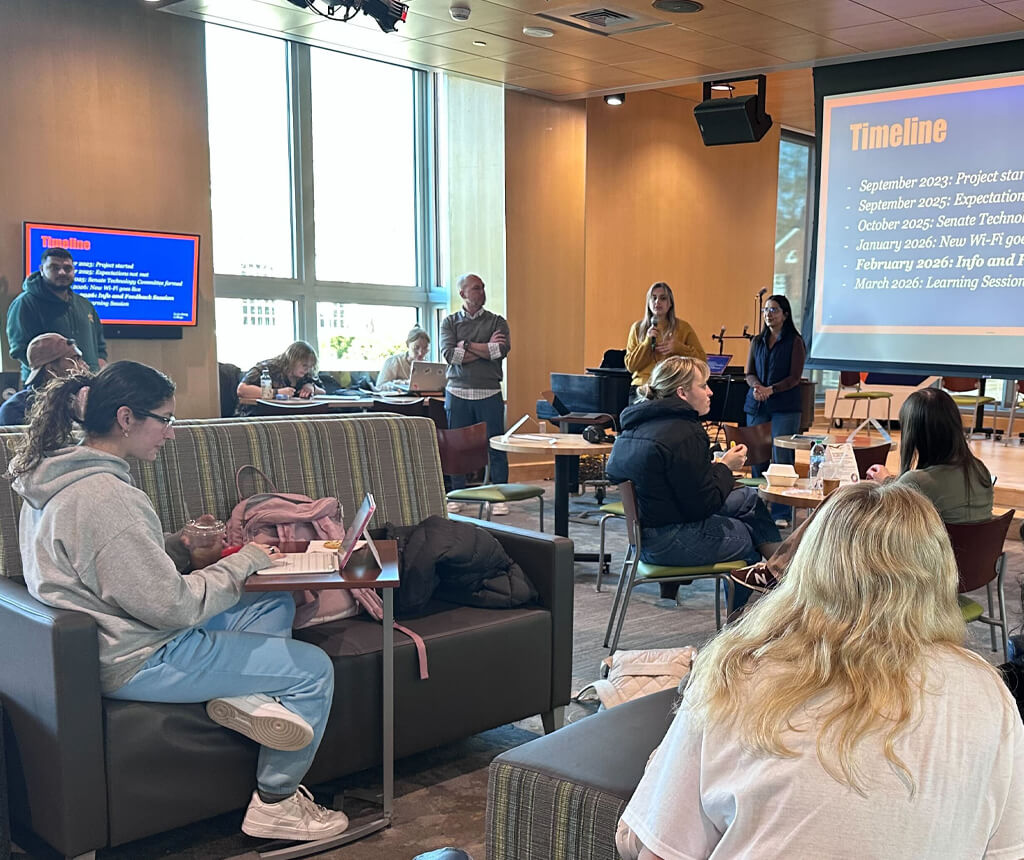
By late January 2026, the four Gettysburg College student ambassadors had been selected and onboarded. We began planning our first discovery tactic: a student-led, town hall-style listening session.
The two student public relations coordinators (both proteges of Gettysburg College’s Eisenhower Institute Expert-in-Residence Susan Eisenhower) worked closely with Velaspan to align session planning with the goal: to gain actionable intelligence by listening closely to what students had to say.
Student turnout was strong. Guided prompts and QR code-based feedback drove lively discussion and data capture across metrics including Wi-Fi pain points, related patterns (location, time, devices), usage (streaming, gaming, academic use), device variability, and perception of “good” versus “bad” Wi-Fi.
Students’ Wi-Fi grievances, we deduced that day, could be organized into five categories:
- Location-based gaps – dead zones and poor coverage in specific spaces including academic, residence, and dining areas
- Intermittent disconnects and variability – sessions or calls dropping sporadically and perceived connectivity lags in specific locations
- Roaming/handoff pain – problems when users moved between spaces
- Configuration/onboarding confusion – repeated login prompts and perceived service failures likely stemming from connecting to the wrong SSID (such as the guest SSID) or from misconfiguring devices (guest versus GBC wireless, for example)
- Expectations mismatch – grievances about coverage in technically challenging areas (elevators, stairwells, some outdoor spots)
“Because we listened constructively, we gained critical information we could not have gotten any other way,” Foster says.
Students took notice.
“The listening session felt like someone genuinely cared about our concerns and wanted to improve the situation,” says Jocelyn Duquette, incoming President of Student Senate. “At a time when so many interactions involve automated systems or AI, it means so much to connect with another person who is actively listening and trying to help, especially when there are student liaisons directing the conversations.”
Following the session, Wi-Fi-related IT support requests decreased, as did YikYak posts—evidence, perhaps, that listening alone had made some difference. Still, our work wasn’t done.
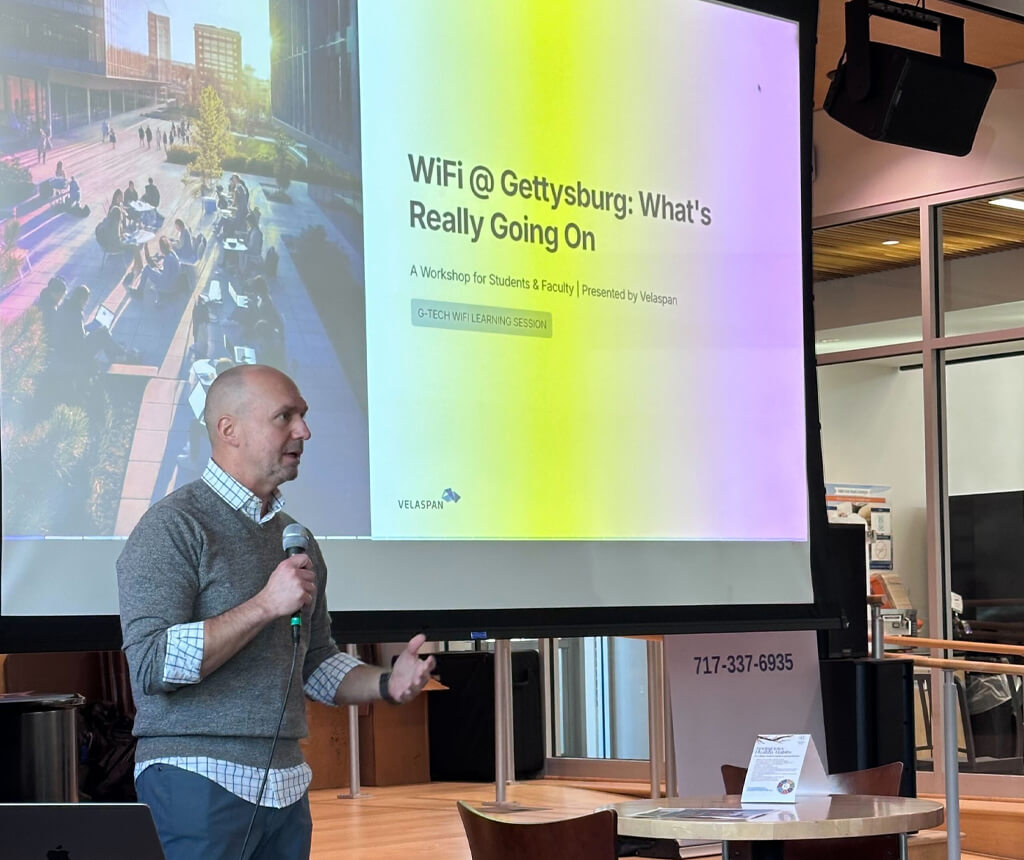
A Wi-Fi learning session came next. Emceed by a Gettysburg College student, led by Velaspan, and similarly well attended, it outlined how Wi-Fi works, where to go for help, and set realistic expectations for performance (Gettysburg College elevators and stairwells are not designed for optimal Wi-Fi performance, for example). Flyers and tabletop A-frame signs placed around campus reinforced the session’s key messaging points.
Next Up: Assessment
With comprehensive qualitative data collection complete, it was time to see how quantitative data compared.
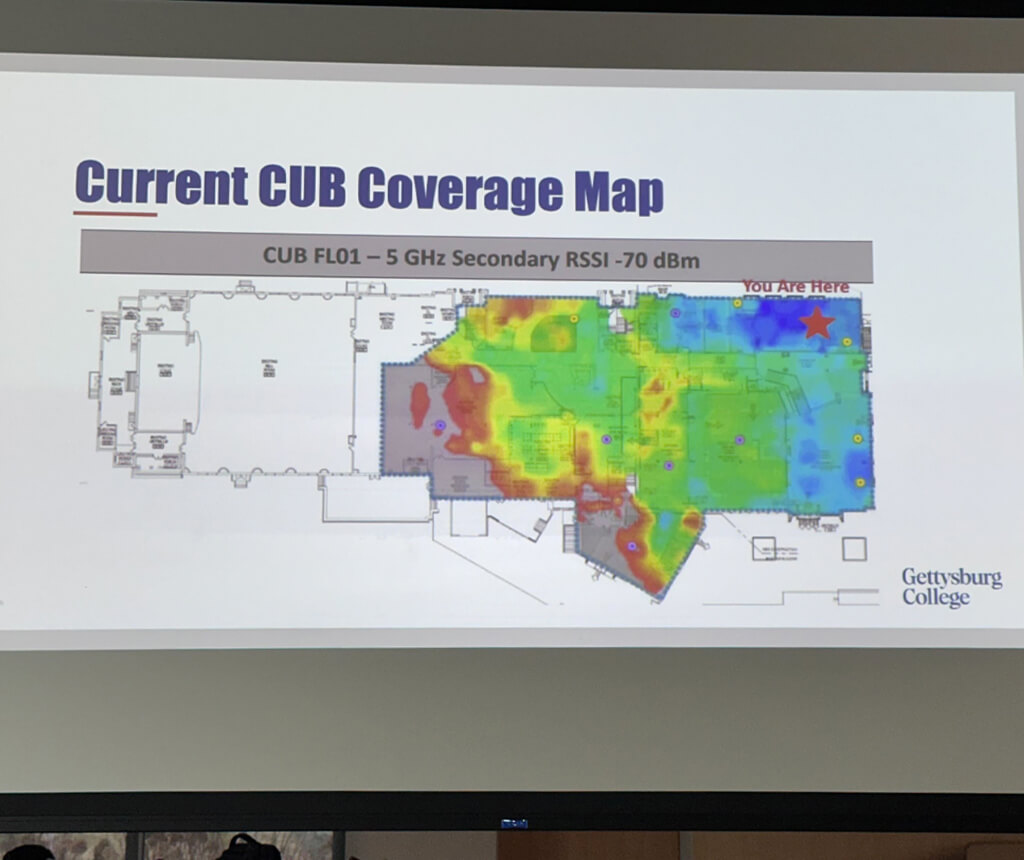
Capitalizing on his Velaspan training, the appointed student data collections engineer helped our engineers conduct wireless site surveys, heat mapping (coverage, SNR, noise floor), and validation of recent infrastructure changes, such as recent deployments of newer access points. The results validated students’ feedback. It also provided welcome news: most of the college’s wireless network problems could be addressed via targeted improvements, tuning, and user education rather than a full wireless network redesign.
Velaspan began training the college’s IT department and student data collections engineer on the specifics of the remediation, enabling them to spearhead network improvements on their own in months ahead.
The Outcome
In late February 2026—two months after the engagement kicked off, with training complete—network remediation responsibility began shifting from Velaspan to Gettysburg College as planned. Our Velaspan team stepped into an ongoing advisory role.
With remediation underway, Gettysburg’s IT and student ambassadors are maintaining the reporting and communication processes established by Velaspan. They’ve also developed some innovative wireless-related initiatives of their own:
- A structured intake form lets students submit wireless feedback to IT on a rolling basis. Their input informs a digital map that shows nuances of coverage campus-wide: where it’s strong, where it’s weaker, any dead zones.
- Recognizing the need to go to students for feedback instead of assuming students will come to them, Gettysburg College IT continues to host feedback and engagement sessions. Additional student engagement efforts include IT support tables set up in high-traffic areas during finals week.
Gettysburg College students continue to notice these efforts and improvements. YikYak complaints have decreased, even as network remediation is still underway. In the Spring of 2026, Duquette formally thanked Gavin Foster on students’ behalf for his department’s renewed commitment to listening.
“Overall, I think students are much happier with the Wi-Fi experience and have a greater appreciation for our amazing IT team and their response.”
– Jocelyn Duquette, incoming President of Student Senate
For Velaspan, the Gettysburg engagement validated a broader principle: campus Wi-Fi success is not measured by signal strength alone. The best outcomes occur when technical assessment, user education, and stakeholder trust support thework in tandem. In Gettysburg’s case, that combination helped turn wireless frustration into a sustainable improvement program the college can continue long after Velaspan’s onsite work is complete.
And there’s one more update worth sharing: since we wrapped up work on campus, Velaspan has received high levels of internship interest from Gettysburg College students. We hope this is evidence of the engagement’s goal from the start—to show that qualified technical expertise combined with qualitative human engagement creates not just stronger Wi-Fi, but something bigger than the sum of its parts. ts parts.
Strong campus WiFi isn’t just about access points and coverage maps. It’s about understanding how people learn, live, and connect. Velaspan brings the technical expertise and collaborative approach needed to turn wireless challenges into opportunities for engagement, education, and lasting improvement.
Let’s Discuss